


Astronomy In Colour
Publisher: Blandford Press
Format: Hardback
ISBN: 071370666X
There are books that quietly introduce a subject, and then there is Astronomy in Colour by Peter Lancaster Brown, which arrives with the full confidence of a man prepared to hand you the universe and point out that, yes, it does in fact come in colours.
Published in 1973 by Blandford Press, this is a splendid survivor from the era when popular science still had a slightly ceremonial feel to it. The title alone is wonderful. Astronomy in Colour. As opposed, one assumes, to astronomy in despair, astronomy in drizzle, or astronomy in the traditional British schoolbook palette of beige and resignation. There is something gloriously optimistic about a book that takes the infinite cold abyss of space and markets it, essentially, as a visual treat.
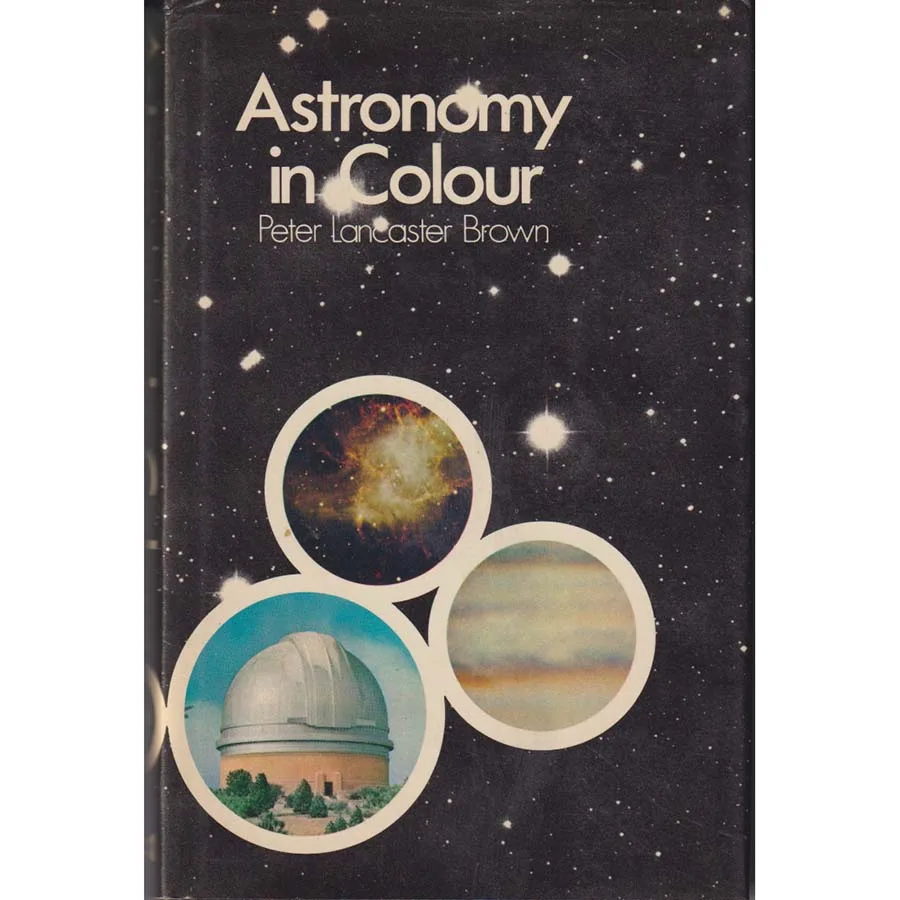
And what a cover. It has everything you could want from early-1970s cosmic publishing: a star-pricked black field, bold white lettering, and a set of circular inset images arranged with the cheerful seriousness of an educational television programme. Nebulae, planets, observatories — the whole thing suggests a world in which science was both majestic and faintly lounge-like. You can practically hear the voiceover: “Tonight, we journey beyond the Earth…” followed by a gentle synthesiser and someone in a polo neck adjusting a telescope.
Peter Lancaster Brown knew his audience. This is not a book for hardened astrophysicists hunting equations dense enough to cause eye strain. It is for the curious reader, the amateur stargazer, the schoolboy with posters of Saturn, the adult who liked the moon landing and never quite stopped looking up. It belongs to that noble category of books designed to make you feel both educated and slightly awestruck while sitting in an armchair.
The phrase in Colour is particularly charming now. In 1973 it would have sounded thrillingly modern, almost extravagant, like a promise of technological glamour. Colour! Imagine! The stars, but not in the usual stern monochrome of old atlases and observatory plates. Today, of course, the phrase has acquired the warm irony of its age. We live in a world where every phone can summon galaxies in absurd resolution, yet there is still something more romantic about a 1973 book proudly announcing that it has managed to make astronomy colourful at all. It is the print equivalent of a family buying its first colour television and immediately watching something educational to justify the expense.
As sold by Crappy Old Books, this copy is in good condition, which is exactly what one hopes for in a vintage science title of this sort. It suggests a life of respectful browsing rather than laboratory abuse. A book like this should look as though it has spent decades on a shelf in a living room, study, or bedroom belonging to someone who enjoyed the idea of the cosmos but also liked a decent cup of tea. Good condition means it has survived the years with its astronomical dignity intact.
It is also a lovely example of how older science books carry a very special kind of optimism. Space, in these pages, is not merely data. It is wonder made respectable. This was an age when astronomy still arrived to the general reader wrapped in a sense of discovery, seriousness, and public uplift. The universe was vast, mysterious, and available in hardback. One did not merely consume content; one learned about the stars.
There is, too, something wonderfully innocent about the promise of the book. Astronomy in Colour suggests that once the heavens are properly illustrated, everything will become clearer. As though the main historical problem with understanding the cosmos had simply been insufficiently vivid printing. It is a marvellous piece of publishing confidence. Billions of years, incomprehensible distances, collapsing stars, planetary atmospheres, galactic structures — but never mind all that, here they are in colour, do keep up.
For collectors, this is a lovely item: a handsome 1970s popular astronomy book with a classic period jacket and a title that encapsulates the era beautifully. For readers, it is a charming reminder of when science publishing aimed to inspire without shouting. For shelf appeal, it is excellent: few covers say “retro intellectual curiosity” more effectively than a black starfield with circular cosmic inserts.
It is also ideal for anyone who enjoys old books that capture a specific historical moment in the public imagination. The early 1970s were still close enough to the moon landings for space to feel glamorous, serious, and just slightly futuristic. Books like this let you step back into that mood: the cosmos as something to be admired, studied, and perhaps discussed by someone with sideburns and a firm view on telescopes.
So here we have a good-condition 1973 voyage into the heavens, offered by Crappy Old Books with all due reverence. It is informative, handsome, slightly period, and unintentionally funny in exactly the right way. The universe may be ancient, indifferent, and unimaginably vast, but this book remains touchingly certain that what you really need is a well-produced introduction from Blandford Press.
Astronomy in Colour is not just a science book. It is a little hardback monument to the age of domestic wonder: when the stars were still best encountered through printed pages, tasteful design, and the thrilling possibility that somewhere beyond the blackness there might be a nebula worth reproducing on coated paper. For anyone who likes their cosmos served with charm, authority, and a faint whiff of 1970s optimism, this is a very fine find indeed.
Keep browsing: See more Space books Other books by Peter Lancaster Brown
